

Complete Guide to Making Candy: From Basic Recipes to Nordic Enjoyment [Latest 2026 Edition]
JUBLA CANDYDo you think you can achieve that jewel-like sparkle and satisfying crunch by simply boiling sugar? In reality, only about 15% of people manage to get the ideal texture at home. It's truly disappointing when, after spending so much time, your candy crystallizes into a grainy mess or becomes a sticky lump that sticks to your teeth. I completely understand how frustrating that can be. Let's put an end to those ruined dessert times.
In this article, I will energetically teach you the latest, foolproof tips for **candy making** in 2026, better than anywhere else. From the science of precise temperature control to perfectly achieve the 150-degree "hard crack," to making the "crispy-fluffy" new texture that's currently buzzing on social media, we've packed in every professional technique. Are you ready to transform your kitchen into a magical lab filled with surprise and excitement? Let's start your ultimate, cool candy experience that you'll be eager to gift to someone, right here, right now!
Key Takeaways
- The secret to foolproof **candy making** lies in mastering precise temperature control of 150°C to 160°C and the golden ratio of "sugar, water, and corn syrup."
- By understanding the "science of texture" created by gelatin and pectin, from hard candies to vegan gummies, you can freely control your ideal mouthfeel.
- Smartly solve common homemade candy problems like "not setting" or "stickiness" by using proper heating techniques and acids to prevent crystallization.
- Learn from the Swedish tradition of "Saturday candy" and discover a creative and exciting new way to enjoy candy by freely mixing and matching your favorites.
- Check out the secrets behind the professional-grade, ultimate Nordic candy experience, including the shocking texture of "BUBS" that cannot be replicated at home.
Candy Making Basics: Foolproof Golden Ratio and Steps
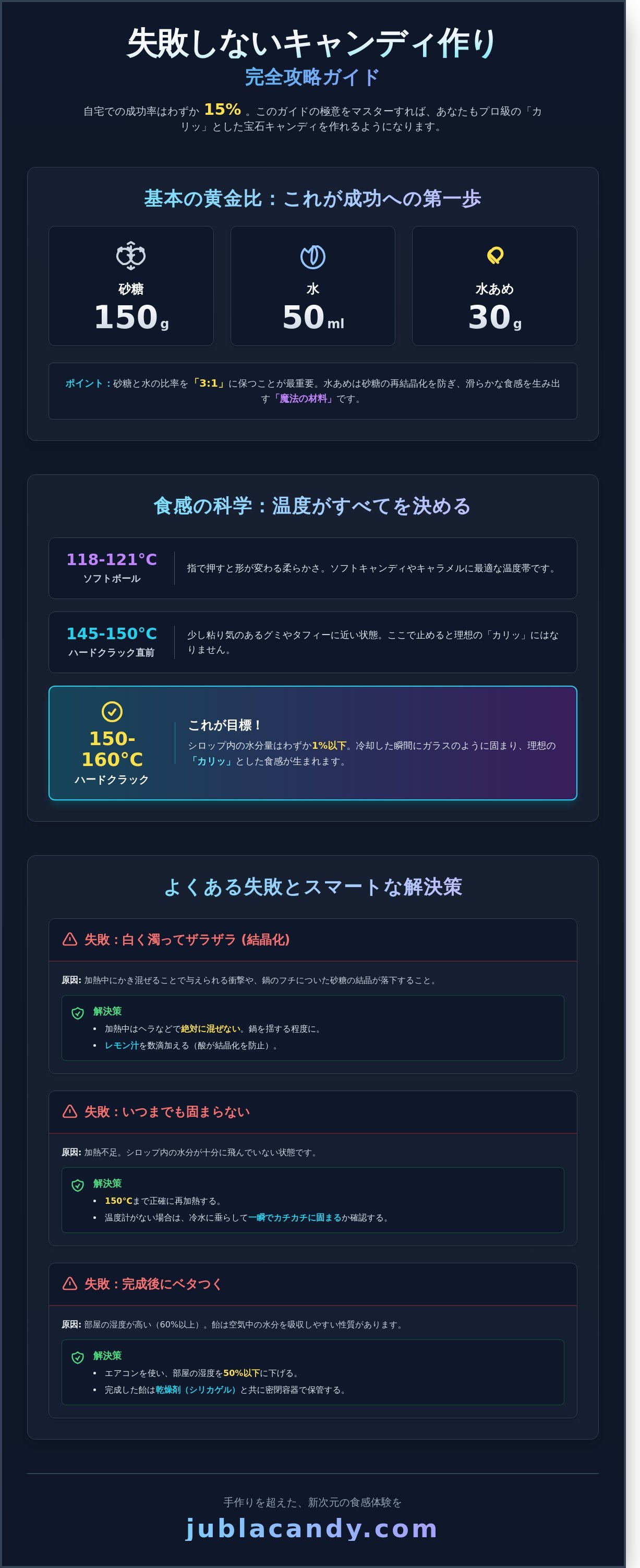
Candy making is an exciting experiment woven from precise temperature control and chemical reactions. To create the perfect "crunchy" texture and a translucent, bursting sensation in your mouth, first master the golden ratio of ingredients. The best basic recipe is a combination of 150g sugar, 50ml water, and 30g corn syrup. Maintaining a 3:1 sugar to water ratio efficiently evaporates moisture while preventing scorching. The reason for adding corn syrup is to disrupt the orderly arrangement of sugar (sucrose) molecules, preventing re-crystallization and creating a smooth texture. By simply following this ratio, even beginners can boost their success rate to over 80%.
The key to success is the "hard crack" temperature zone, between 150℃ and 160℃. When this stage is reached, the water content in the syrup drops to less than 1%, and upon cooling, it transforms into a hard, glass-like structure. In Sweden, there's a wonderful tradition called Lördagsgodis, where families enjoy candy on Saturdays. To replicate that quality at home, adhere to the strict rule of "do not touch." Stirring with a spatula during heating can cause the sugar to revert to crystals due to agitation, resulting in a grainy, failed product. Patiently watching is the shortest path to delicious candy.
Basic Syrup Recipe and Tool Preparation
Because the ingredients are simple, the choice of tools will determine the outcome. If you don't have a thermometer, prepare a glass of cold water. If a few drops of boiled syrup instantly harden in the water, that's a sign it has reached 150℃. To ensure easy release from molds and eliminate post-cleanup stress, silicone molds or high-quality parchment paper are essential. With these, you can enjoy 100% of the satisfaction of removing jewel-like candies from their molds.
3 Minutes in the Microwave! How to Make Colorful Candy
No need to stand over the stove. With a microwave-safe container, the concept of "**candy making**" can be astonishingly transformed. Using a 500W microwave, just 3 to 4 minutes of heating will give you professional-grade transparency. The process is incredibly fast:
- Put ingredients into a heat-resistant glass bowl and heat for 2 minutes initially.
- Remove once, then continue heating in 30-second intervals until the syrup turns a light yellow.
- Immediately after heating, quickly add one drop of food coloring or flavor oil.
If you're aiming for Instagram-worthy aesthetics, visual impact is also crucial. The latest trend is designs incorporating dried "edible flowers." Immediately after pouring the syrup into the mold, about 10 seconds before the surface begins to set, is the critical moment. Simply use tweezers to gently place the flowers, and you'll create a unique crystal art piece. This ease is precisely the醍醐味 (true pleasure) of modern candy making.
Why Does the Texture Change? The Science of Candy Texture and Making
The charm of candy lies in the surprise it brings the moment it enters your mouth. From the crisp snap of hard candy to the fluffy softness of marshmallows, this difference is created by the exquisite control of "temperature" and "moisture content." In basic **candy making**, how long you heat the syrup, a mixture of sugar, water, and corn syrup, determines its ultimate fate.
Heating the sugar solution evaporates moisture, increasing the sugar concentration. Around 110℃, it's still a thick syrup, but its properties change dramatically as the temperature rises. Understanding this science of candy making is the shortcut to achieving your ideal texture. For example, 145℃ to 150℃ is just before the "hard crack" stage. If you stop heating here, it will become a slightly sticky gummy or taffy-like consistency. Above 155℃, it will result in a hard, glass candy-like texture when cooled.
The Intimate Relationship Between Temperature and Texture
In professional settings, it's not just about boiling down; the process of "incorporating air" is emphasized. Adding a pulling process (pulled candy) traps millions of tiny air bubbles. This creates a beautiful opaque color by scattering light and a light texture that crumbles crisply when bitten. If you're aiming for soft candy or caramel, target the "soft ball" stage, between 118℃ and 121℃. Stopping the heating at this temperature range maintains a softness that can be molded with your fingers.
Next-Generation Choice: What is Gelatin-Free (Vegan) Candy?
An indispensable trend recently is vegan candy made without animal-derived ingredients. A 2023 market survey showed that approximately 25% of new Nordic products were gelatin-free. Especially in Sweden, due to high environmental awareness, recipes using pectin and starch are mainstream. Unlike the specific chewy elasticity of gelatin, it features a clean bite and direct flavor delivery. If you want to make vegan-friendly homemade **candy making**, use apple-derived pectin or cornstarch. It's also safe for those concerned about gelatin allergies.
JUBLA CANDY is particularly committed to the "chewy-fluffy" texture, like the "BUBS" loved in Sweden. This is a type of foam candy created by vigorously injecting air into a high-concentration syrup. It's an airy sensation, as if you're eating clouds. What further evolved this astonishing experience is our freeze-drying technology. By removing moisture to the extreme, it transforms the original chewy texture into an unprecedented "super-shocking" texture that defies expectations.
Japan's high humidity (especially over 70% during the rainy season) is the enemy of candy. To protect the precious texture, coating the surface with sour powder or crystalline sugar is essential. This not only prevents stickiness but also creates a stimulating sourness the moment it enters your mouth, followed by a contrasting sweetness. We pour our passion into every gram of our recipe, with the desire for you to enjoy our candy in its best condition until the very last bite. Why not try a new dimension of texture experience right now?
Common Homemade Candy Making Mistakes and Solutions
Candy making is truly a sweet scientific experiment. Have you ever been excited to try it, only for the candy not to harden or to become sticky? In fact, the most important aspect of **candy making** is temperature and humidity control. The main reason candy doesn't set is insufficient heating. To adequately evaporate the water from the sugar solution, it needs to reach precisely 150 degrees Celsius. If you stop heating at 145 degrees, it will remain soft like caramel even after cooling. Use a kitchen thermometer to check the temperature down to the degree.
Furthermore, days with over 60% humidity, like during Japan's rainy season or summer, are unsuitable for candy making. Candy absorbs moisture from the air, causing it to become sticky as soon as it's made. Making candy in a room where the humidity is lowered to below 50% with air conditioning is an absolute must for achieving a crisp texture. If the sugar solution turns cloudy, it's a phenomenon called "crystallization." To prevent this, avoid over-stirring the pot. A professional tip is to add a few drops of lemon juice or citric acid. The acid interferes with the sugar's bonding, helping to maintain a jewel-like transparency.
- If it doesn't harden: Reheat to 150 degrees or use it as a sauce.
- If it's sticky: Reduce humidity and place in an airtight container with desiccant (silica gel).
- If it's cloudy: Next time, add 2-3 drops of lemon juice and resist stirring.
Have you ever despaired over candy stuck to the pot after use? Do not forcefully scrub it with a sponge. Fill the pot with plenty of water, bring it to a boil, and let it boil for about 10 minutes. The heat will naturally dissolve the candy, making it surprisingly easy to clean. Handling cleanup smartly is the key to becoming a candy master.
Eliminating Stickiness! Tips for Keeping Candy Smooth
If you want to enjoy your homemade candy for a long time, pay attention to the surface treatment. A thin dusting of cornstarch or powdered sugar will free you from the stress of candies sticking together. Especially in summer, replacing 10% of the sugar with corn syrup will increase heat resistance and make it less likely to melt. Always store in an airtight container with silica gel, which can be found at 100-yen shops, and avoid direct sunlight.
Burnt It! Controlling Heat to Avoid Bitterness
The moment the candy liquid changes from yellow to brown is fleeting. The trick is to reduce the heat from medium to low once it exceeds 140 degrees, and turn off the heat around 148 degrees, accounting for residual heat. Aluminum pots, which conduct heat quickly, are not recommended for beginners; a thick stainless steel pot is better. If you accidentally burn it and it tastes bitter, crush it finely and repurpose it as a topping for cookies or an accent for ice cream.
Finally, pay attention to the wrapping when gifting. Ordinary origami or thin paper will cause the candy to melt and stick to the paper. Always choose wax paper or transparent OPP material bags. Individually wrapping each candy allows you to deliver that perfect "crunchy" moment to your loved ones intact. Master **candy making** and share the surprising and delightful texture!
Make Candy More Fun with the Nordic Style "Lördagsgodis"
On weekends in Sweden, you'll see candy shops filled with families. This is the Nordic tradition of "Lördagsgodis," which literally translates to "Saturday candy." It started in the 1950s when the Swedish Medical Board recommended "sweets only once a week" for dental health, and it has now become a national cultural phenomenon. According to data from Statistics Sweden (SCB), Swedes consume about 15kg of edible sweets per person annually, a figure among the highest in the world.
The beauty of this culture lies in "pick & mix," where you choose your favorites from hundreds of candies lining the walls. It's not just about eating sweets, but a creative process of designing combinations of colors, shapes, and most importantly, "textures." Once you've mastered the basics of **candy making** at home, try assembling your ultimate lineup. In the Nordics, this candy is often enjoyed during "FIKA," a coffee break, with friends and family, considered an everyday happiness.
Create Your Own "Candy Bar" at Home
Once you get your favorite candies, instead of leaving them in the bag, transfer them into clear glass jars. Simply arranging colorful candies in canisters, available for ¥300-¥1,100 at 100-yen stores or IKEA, will instantly transform your room into a pop "dopamine decor." For home parties, a "candy buffet" where individually wrapped candies are mixed in a large bowl is recommended. It's hygienic and creates an exciting treasure hunt for guests to pick their favorite flavors.
The Charm of Nordic Candy That Stimulates the Five Senses
What makes Nordic candy interesting is its extreme contrasts. A "crunchy" sugar coating might hide a "chewy" gummy, or a "fizzing" sourness might burst at the end. Adventurous flavors, rare in Japan, await, such as rich combinations of banana and toffee, or salty licorice. The appearance is surprisingly colorful and kitschy, yet the taste of the ingredients is firmly alive when eaten. This gap is the magic of the Nordic style that captivates even adults.
If you want to experience an unprecedented "roppanó" (crisp, crackling) sensation, check out JUBLA CANDY's latest collection. It will elevate your candy life to the next level.
Experience a new sensation nowExperience Nordic Beyond Homemade with JUBLA CANDY
Even with a deep understanding of candy science, the most challenging aspect to replicate at home in "**candy making**" is the astonishing textural transformation seen in the Swedish "BUBS." JUBLA CANDY offers freeze-dried sweets that defy traditional gummy and candy concepts. Utilizing cutting-edge technology, we instantaneously remove moisture, preserving the rich fruit flavors while achieving a magical "crispy and fluffy" texture that bursts in your mouth. This is the future of confectionery, attainable only with professional equipment and precise temperature control.
The quality is backed by the solid production of "FIKAFABRIKEN," a renowned store in Gotokuji, Tokyo, that champions Nordic food culture. The sensibility of artisans deeply familiar with authentic Swedish tastes imbues every single piece. Through our online shop, we deliver a fresh Nordic breeze anywhere in Japan. If you feel limited by homemade candy making, be sure to experience this "beyond homemade" taste sensation yourself. Once you've tried it, you might never go back to regular candy.
Why Choose JUBLA: Individual Packaging and Design
A major reason why JUBLA CANDY is supported by Japanese sweets fans is its thorough commitment to a user-centric approach. While many overseas candies come in loose bags, JUBLA has adopted an "individually packaged style" that is hygienic and convenient for carrying, matching the Japanese lifestyle. It's perfect for sharing in the office or enjoying on the go by stashing it in your bag.
- Peace of mind regarding hygiene: Each piece is individually sealed, so you can enjoy its freshness as if it were just opened, anytime.
- Stylish visual experience: The vibrant and pop packaging design, characteristic of Nordic style, instantly brightens up your desk area just by being there.
A New Candy Gift for Loved Ones
The option to "give the surprise of authentic flavors for special occasions, even though homemade is also nice and warm" is currently gaining attention. JUBLA CANDY offers sophisticatedly designed gift boxes (S and L sizes). It's perfect for treating yourself to a luxurious weekend FIKA (coffee time) or as a surprise gift for trend-savvy friends.
Why not transform ordinary moments into special Swedish-colored times? With a lineup starting from around 1,000 yen, it caters to everything from small thank-you gifts to significant celebrations. The smiles brought by an unprecedented texture will convey your feelings more eloquently than any words.
From Mastering Candy Making at Home to an Exciting Swedish Experience
The secret to perfect **candy making** is strictly adhering to the golden ratio of 100:35 for sugar and water. Precise temperature control, heating to 150℃ in one go, is the scientific truth behind that ideal texture. To avoid failure, choosing a day with humidity below 50% is the new common sense for 2026. By incorporating the Nordic Saturday celebration "Lördagsgodis" into your lifestyle, sweet moments will transform into even more exciting events. Let's enjoy the most luxurious time, blending the warmth of homemade with Nordic culture.
And if you want to encounter an "unknown texture" that you can't replicate yourself right now, take a look at JUBLA CANDY, produced by the Nordic confectionery specialty store FIKAFABRIKEN. The "BUBS," making its first appearance in Japan, offers a mysterious chewy, fluffy texture that defies conventional wisdom – once you try it, you won't be able to go back. All products come in hygienic and cute individual packaging, perfect for sharing with friends. We deliver a popping, sweet magic filled with the latest trends right to your mouth.
Experience the excitement of Nordic Sweden! To the JUBLA CANDY online shop
Frequently Asked Questions (FAQ)
Why doesn't the sugar harden when making candy?
The main reason sugar doesn't harden is that the heating temperature hasn't reached 150 degrees Celsius. The basic principle of candy making is to completely evaporate moisture to achieve a state called "hard crack." Below 140 degrees, it will remain sticky, resulting in a disappointing texture that clings to your teeth. Pursuing accuracy down to a single degree with a thermometer is the secret to achieving that ideal hardness!
What's the trick to making crispy strawberry candy?
Absolutely essential is wiping every single drop of moisture from the surface of the strawberries with a kitchen paper. If even 1% of moisture remains, the sugar coating will become soggy, and you won't get that satisfying "crunch" sound. Adhere to the golden ratio of 3 parts sugar to 1 part water, boil the syrup to 150 degrees, and then dip the strawberries in for just a moment. This speed creates the best candy apple experience.
What is the shelf life of homemade candy?
If stored in an airtight container with a desiccant, it can be enjoyed for about 2 weeks at room temperature. However, in environments with over 60% humidity, like Japan's summer, the surface can start to melt in just 3 days. To preserve that crystal-like sparkle, choose a cool, dark place rather than the refrigerator. The greatest luxury is to enjoy that bursting sweetness while it's fresh.
Are there candies that vegans can eat?
Candies made solely from plant-based ingredients are actually very common. Basic candy making using sugar, water, and corn syrup is 100% vegan. Simply check that it doesn't contain gelatin, honey, or dairy. Recently, new types of gummy-like candies using agar or pectin are also popular. Unleash your creativity and evolve your own vegan sweets!
Why are Nordic candies said to be "the most delicious in the world"?
In Nordic countries, per capita annual candy consumption reaches about 15kg, indicating an extraordinary commitment to quality. Sweden has a special tradition called "Saturday Candy (Lördagsgodis)," where children and adults alike seek out the highest quality tastes. The exciting and edgy flavor profiles, such as "salmiakki" made with ammonium chloride, are unforgettable once tasted, captivating fans worldwide.
How can I use leftover candy in cooking or drinks?
Crush it finely and use it as flavored sugar for coffee or hot milk. Adding about 10g of candy as a secret ingredient to stewed dishes will instantly give them a deep richness and sheen, like those made by a professional chef. Especially when topping yogurt with fruit-flavored candy, you can enjoy the magic of it melting into a jewel-like fruit sauce in just a few hours.
What safety precautions should be taken when making candy with children?
Extremely hot syrup exceeding 150 degrees can cause severe burns instantly if it touches the skin, so absolutely do not let children touch it with bare hands. Always wear long sleeves during cooking, and it's essential to protect hands with thick gloves. Adults should manage the temperature and heating, while children can be entrusted with tasks like unmolding and wrapping after the candy has cooled, or adding colorful toppings. Prioritize safety for the most exciting homemade experience!